

 DBI Infomatics Research Desk
At a glance
- The 30% annual churn rate: Every year, approximately 30% of your B2B contacts change jobs, switch phone extensions, or leave organizations entirely.
- The six core quality dimensions: Comprehensive data health requires evaluating Completeness, Accuracy, Consistency, Timeliness, Validity, and Uniqueness.
- The true cost of bad CRM data: Sales reps spend 20% of their selling hours wrestling with incomplete fields, false duplicates, and bouncing email addresses.
- Enforcing continuous SLAs: Establishing monthly data governance SLAs keeps email bounce rates below 1.5% and protects core outbound domain reputation.
The Silent Epidemic of CRM Database Decay
B2B data is inherently perishable. Unlike physical assets that depreciate on predictable accounting schedules, customer and prospect databases decay quietly and continuously. Every single month, roughly 2.5% of your CRM records become obsolete—key executives change employers, companies undergo mergers or rebrandings, corporate domains migrate, and phone switchboards disconnect.
Left unchecked for just 12 months, nearly a third of your entire CRM repository becomes toxic. Outbound emails begin to bounce, sales reps waste hours dialing disconnected lines, marketing automation sends irrelevant nurture cadences to former employees, and executive pipeline forecasting becomes complete fiction.
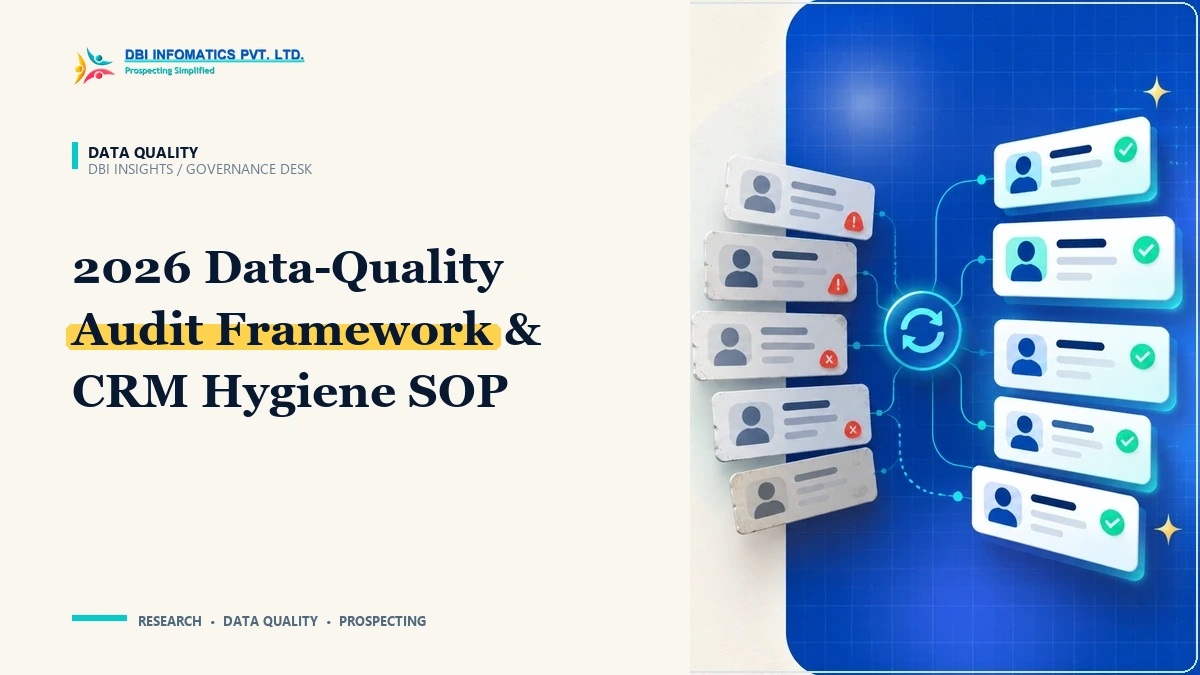
Maintaining high sales velocity requires moving away from reactive emergency cleanups to a continuous data-quality audit framework.
The 6 Pillars of B2B Data Quality
To accurately assess the health of your sales and marketing database, RevOps leaders must audit records across six core dimensions:
- Completeness: Are mandatory fields populated? (e.g., Target Account profile has valid revenue range, employee headcount, corporate domain, and city).
- Accuracy: Does the data represent real-world truth? (e.g., Does this individual actually hold the title of VP of IT at this company today?).
- Consistency: Are values standardized across all tables? (e.g., State fields use standardized 2-letter ISO codes rather than random mix of abbreviations and full names).
- Timeliness: When was the record last verified? Any contact record unverified for more than 180 days is suspect.
- Validity: Does the data satisfy technical syntax constraints? (e.g., Valid RFC-compliant email formatting and E.164 international phone number structure).
- Uniqueness: Are duplicate accounts and contacts detected and merged into a single Golden Record?
| Audit Capability | Automated Regex & Script Scrubber | Comprehensive Human Desk Audit (DBI Standard) |
|---|---|---|
| Email Deliverability Validation | Checks basic MX records and ping response only; misses catch-all traps | Full SMTP handshake verification plus human validation of active role |
| Job Change & Title Verification | Zero visibility: cannot detect when an executive was promoted or left | 100% verified via active corporate press releases and public profiles |
| Duplicate Merging Logic | Rigid: merges only exact domain matches, missing subsidiary variations | Context-aware: correctly identifies parent-child holding relationships |
| Phone Number Reachability | Formats digits according to country code without verifying live line | Direct dial testing: verifies direct extension and live connectivity |
| Post-Audit Usability | Generates raw error CSV with thousands of unassigned flags | Direct CRM upload: delivers clean, normalized, ready-to-prospect records |
The Data Quality Audit Scorecard & Rubric
Before launching major sales initiatives, score your database using this 4-tier rubric:
- Tier A (Pristine Health - 95%+ Accuracy): Bounce rates below 1.5%, zero duplicate master accounts, all core firmographic fields complete. Safe for automated executive cadences.
- Tier B (Acceptable Health - 85%–94% Accuracy): Bounce rates between 1.5% and 3.5%, minor formatting inconsistencies. Requires targeted enrichment before high-volume outbound.
- Tier C (Degraded Health - 70%–84% Accuracy): Bounce rates between 3.5% and 6%, widespread duplicate records, missing direct dials. High risk of domain deliverability damage.
- Tier D (Critical Failure - <70% Accuracy): Hard bounce rates above 6%, rampant duplicates, obsolete job titles. Immediate outbound freeze required to avoid permanent domain blacklisting.
Enforcing RevOps Data Governance SLAs
A data audit is only valuable if quality standards are maintained over time. Enforce strict RevOps Service Level Agreements (SLAs): mandate that no new account can be created without verified industry and revenue tags, and schedule automated quarterly remediation sweeps to prune decaying records.
Frequently Asked Questions
How frequently should a B2B company conduct a full data quality audit?
Fast-growing B2B sales organizations should conduct a high-level data health check monthly and a comprehensive deep audit every quarter. Waiting once a year allows data decay to accumulate past the point of easy remediation.
What is an acceptable email bounce rate for B2B outbound?
A healthy B2B outbound engine maintains an email bounce rate below 2%. Anything above 3% begins to damage your domain reputation with Google Workspace and Microsoft 365, while bounce rates over 5% trigger severe spam-filter penalties.
How does DBI Infomatics execute database cleansing and remediation?
DBI runs a multi-stage audit: parsing records for syntax errors, deduplicating account trees, verifying active employment status, testing email deliverability, and replacing obsolete records with verified current decision-makers.
Need to operationalize this for your pipeline?
DBI Infomatics builds custom research, continuous enrichment, and verification workflows tailored to your specific account tiers and CRM schemas.
Talk to the DBI Research Team →